At the end of September, we joined our buddies Mike, Mary, Jose, and Andrea for one final hiking and climbing adventure in the Dolomites … and it was awesome. But before we get into the details of the trip, we feel that a little explanation of ‘huts’ may be needed.
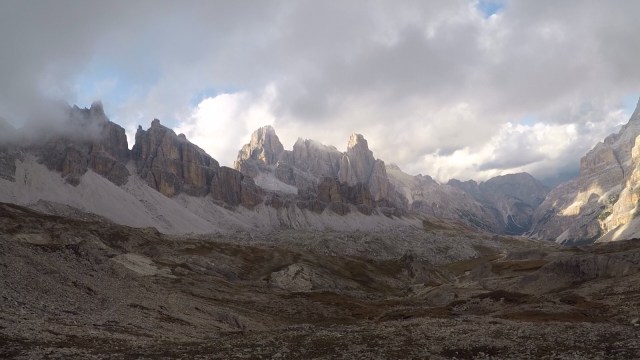
Throughout Europe, there is an extensive network of huts used by hikers, climbers, and depending on accessibility, non-extreme individuals alike who are looking for a rustic mountain escape. The quality and luxury vary from hut to hut, but there are typically a few common factors:
- Blankets and pillows are provided by the hut, but travelers are responsible for linens. Given the nature of our trip (lots of hiking and climbing), we were conscious of the weight and size of our bags. As such, we used sleep sacs (basically sleeping bags but made only of cotton) and shammy towels. These compact linens allowed us to keep our packs small and light (which allowed for a much-needed bottle of booze).
- Huts usually come with half-board. As relative newbies to huts, we can’t say that the following applies to every establishment, but the places we stayed in had fabulous food. Considering we were thousands of meters in the mountains sometimes with no gondola or car access (definitely never, ever both), the food they turned out was pretty spectacular.
- Showers are optional. The first hut we stayed in charged €3.50 for a shower which consisted of 25 liters of hot water. It was just enough to rinse off a days worth of grime and sweat, and it was money well spent.
- Most huts prohibit hiking/climbing shoes inside their establishment, but they also realize that these are likely the only shoes that travelers have. Consequently, they provide house slippers for every guest. It’s a wonderful little luxury.
- Sleeping arrangements are typically in a dormitory style, and whether you’re in a small room with friends or sharing a large room with strangers, earplugs are a must.
Huts now explained, here’s a general overview of our 3-day, 2-night amazing adventure through the Dolomites:
Day 1: Up to Rifugio Lagazuoi
Day 1 was a very early morning. We left Basel before 5-am and were able to catch up with our pals from Zurich on the road. After a 7-hour car ride and a few stops for errands (country vignettes, maps, car parks, etc.), we finally arrived at the base of the mountain around 2-pm and began our adventure up into the mountains. The first part of our ascent was a Via Ferrata, and while it was less difficult than other courses we’ve climbed, the Dolomites style presented its own challenges. This style, apropos to our location, has fewer steel supports than the French/Swiss style. There is still a steel line to which we were always clipped into, but the hand and foot holds for climbing are mostly natural. As such, the responsibility is more on the climber and less on the course designer. This difference took a little while to get used to, but in the end, we both now prefer this au naturel style.

Where’s Waldo – Dolomite Edition

We made it to the top … sort of

Group Pic
After finishing our first climb, we still had a rather demanding hike ahead of us. We don’t know how many meters we had to climb, but we do know that it was about an hours worth of very steep, uphill hiking. Generally speaking, we don’t really like hiking (we both tend to get a little bored … and sometimes lost), but this trip was a little different. For starters, the scenery was absolutely stunning, and to top it all off, we passed a few preserved WWI bunkers along the way. Very cool stuff.
We finally arrived at the hut just before sundown, and after a much-needed shower, we settled in for a tasty dinner, a couple of dice games, and an overall enjoyable evening with pals.
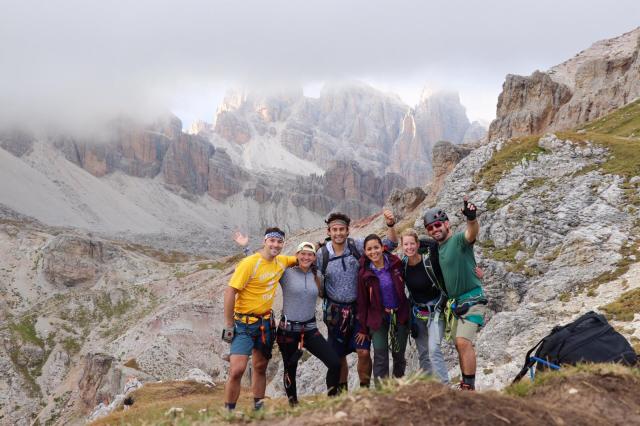
Day 2: Rifugio Lagazuoi to Rifugio Dibona
Day 2 was another early start. We dined with the rising sun and were headed down the mountain before our legs and minds really had time to process the days promised physical challenges. After about 90 minutes of hiking, we found ourselves at the start of our next Via Ferrata. At first glimpse, the start was a little ominous looking – tiny ladders leading straight up into a dark tunnel. But we put on our gear and ventured ahead. The tunnels are actually left over from WWI and were used by the Allies to quickly and safely traverse the mountain without enemy detection. The tunnels and line are all well maintained, but a headlamp and climbing gear were essential. We spent about 20 minutes hunched over, relying solely on our headlamps and the steel line to bring us out safely to the other side of the mountain.

Hike to the second Via Ferrata

Exiting the Tunnels

Which way?
The rest of the Via Ferrata was much like the previous day – full of incredible views and awesome climbing opportunities. We finished our climb in the early afternoon with enough time to summit the peak; however, we were a little worried about the weather, so we decided after a quick photo shoot to head straight down to our hut for the night. Unlike the first day, our afternoon hike was all downhill, but we would both argue (perhaps Sarah more fervently so) that down is way harder than up. We arrived at the hut exhausted and ready for a much-deserved adult beverage.

On top of the world

Perspective
Day 3: Down and Back Up to Tre Cime di Lavaredo

Leaving Dibona

Day 3 Morning Views
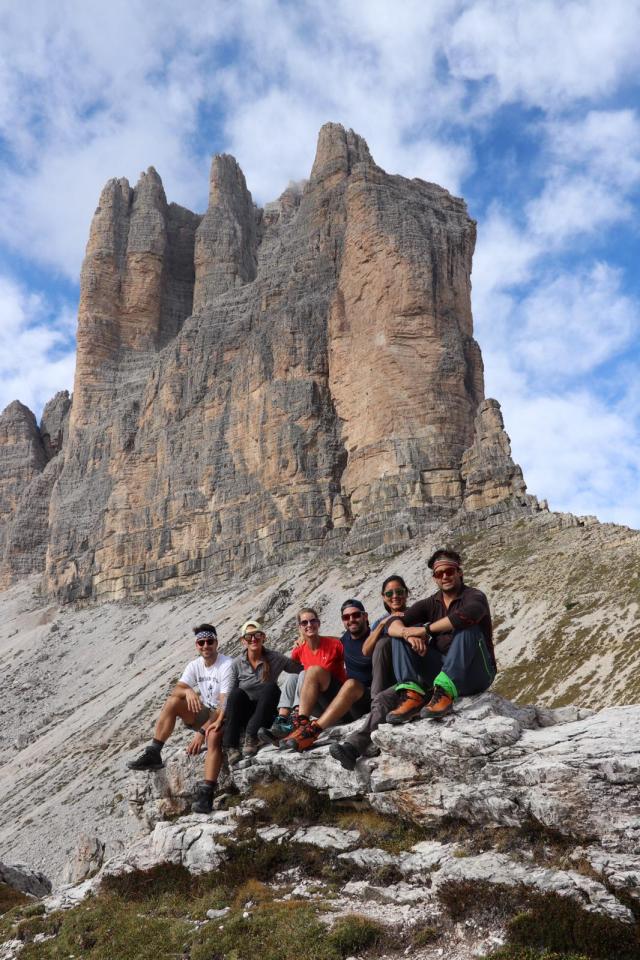
Our last day was just the most perfect weather, and none of us wanted to waste a day in the car. As such we hiked down to our cars and decided to drive across a valley and up to Tre Cime di Lavaredo before heading back home. After two solid days of hiking and climbing, our legs were all pretty sore, but we pushed through for one final hike. We will let the pictures below speak for themselves.
Final Goodbyes
Sadly, this was our last adventure with our dear friends, Mike and Mary. They have since moved back to the states and are settling into their new lives in Atlanta. We will miss them dearly but are happy to have had one final epic adventure together.



 SASgoesSwiss